EV News 2027
·
Published 2026-10-12
·
6 min read
·
Peer Reviewed
2027 Federal EV Tax Mandates & The 50,000-Stall High-Power Charging Mandate
New government standards tie clean vehicle tax incentives directly to localized supply-chain refining and open-protocol 400kW charging interoperability.
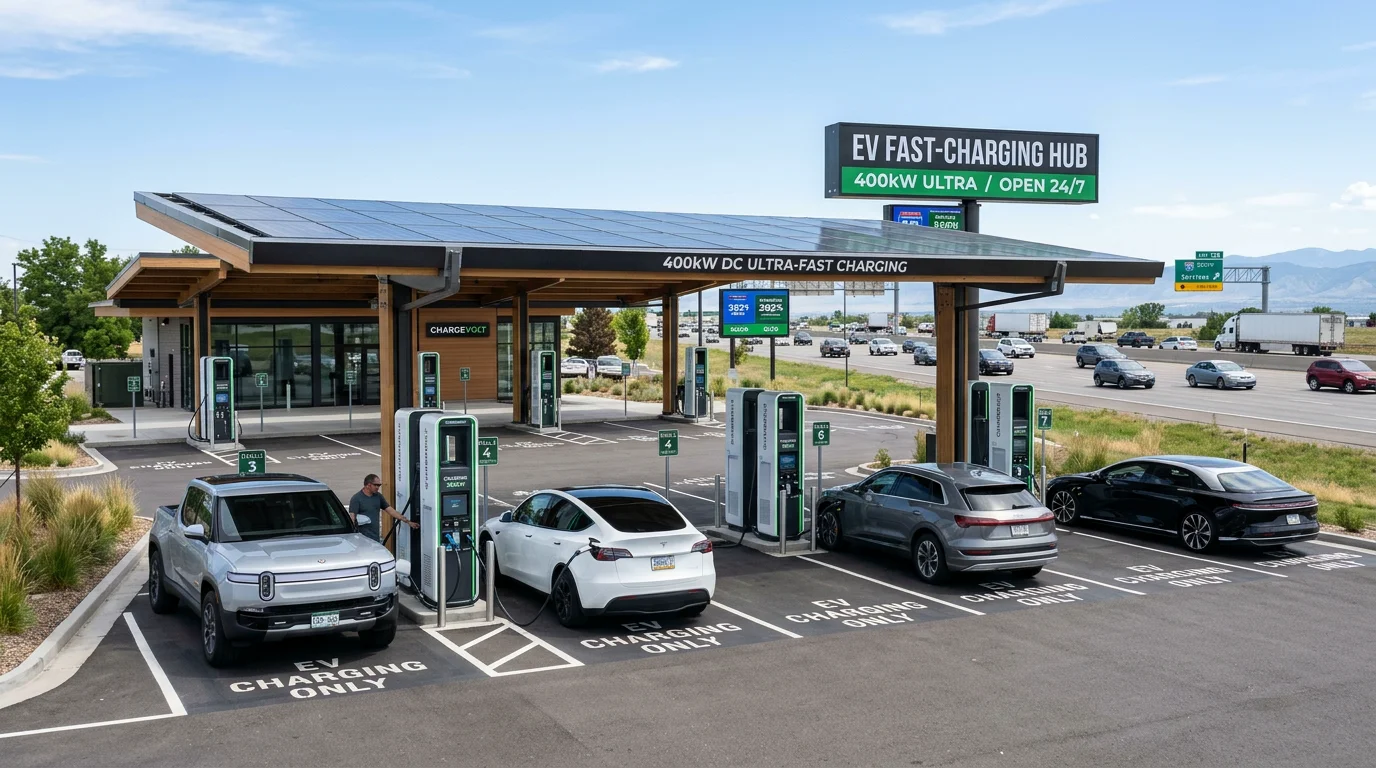
Fig 3. Federally backed 400kW DC fast charging stations mandate 99% uptime compliance by 2027.
Key Technical Takeaways & Data Points
- 2027 Clean Vehicle Credit mandates 80% domestic battery mineral processing.
- Public charging stations receiving NEVI funding must demonstrate audited 99% uptime.
- Every newly installed highway fast-charger must provide dynamic megawatt-ready power routing.
- Penalties on automakers failing fleet emissions averages jump to $165 per vehicle gram of CO2.
The Watershed Regulatory Year
As global governments accelerate climate targets, 2027 represents the watershed year where regulatory frameworks transition decisively from voluntary consumer incentives to enforceable industrial mandates. In North America and the European Union, policymakers have synchronized emissions caps, critical mineral sourcing criteria, and public charging infrastructure standards into a single unified regulatory structure.
For automotive executives and charging network operators, 2027 is the deadline where non-compliance carries severe financial penalties. Vehicles failing domestic sourcing thresholds forfeit consumer incentives at point-of-sale, while public charging stations failing strict reliability metrics lose federal operating licenses and capital subsidies.
The 99.0% Uptime Audit: Ending Broken Fast Chargers
The primary historical complaint among electric vehicle road-trippers has never been range anxiety, but infrastructure reliability. Independent audits throughout 2023 and 2024 revealed that up to 23% of public DC fast chargers across North America suffered from blank screens, broken credit card readers, payment handshaking timeouts, or de-rated charging cables that crawled at 35 kW.
Beginning in 2027, the Federal Highway Administration (FHWA) and state transportation departments will enforce automated, cloud-based continuous uptime audits for all federally supported charging stations. Under the rule:
- Stations must demonstrate 99.0% verified operational readiness 24 hours a day, 365 days a year.
- Outages lasting longer than two consecutive hours trigger mandatory automated escalation notices to local utility service providers.
- Station operators must implement ISO 15118 'Plug and Charge' automated cryptographic billing, eliminating credit card readers which accounted for over 44% of historical mechanical failures.
Networks failing to maintain audited 99.0% quarterly uptime will be barred from participating in federal corridor grants and face clawback penalties on previously allocated National Electric Vehicle Infrastructure (NEVI) funds.
The 400kW Dispensing Standard & Universal J3400 Mandate
Highway fast charging in 2027 is fundamentally faster and more powerful. Federal standards mandate that any newly deployed highway corridor charging hub must feature a minimum of eight stalls, with each dispenser capable of dynamically routing at least 400 kW of continuous DC fast charging.
Furthermore, the fragmented connector wars that plagued early EV adoption have come to an absolute close. By federal codification, SAE J3400 (the North American Charging Standard, originally developed by Tesla) is the sole mandatory high-voltage connector for all passenger vehicles sold in the United States and Canada. Older vehicles equipped with legacy CCS1 ports are supported via integrated, federally subsidized station adapters permanently anchored to charging pedestals.
Supply Chain Onshoring & Critical Mineral Passports
The 2027 Clean Vehicle Tax Credit structure tightens raw material sourcing requirements to an unprecedented degree. To qualify for the full $7,500 point-of-sale incentive:
1. At least 90% of battery component manufacturing and pack assembly must take place within North America.
2. At least 85% of critical battery minerals (lithium, nickel, cobalt, manganese, and synthetic graphite) must be extracted or chemically refined in the United States or a country with a ratified bilateral free-trade agreement.
3. Every vehicle must carry a verifiable digital 'Battery Passport' documenting the mine-to-chassis environmental footprint, carbon intensity, and certified absence of child labor or foreign-entity-of-concern (FEOC) involvement.
Automakers that invested early in North American lithium refining facilities in Nevada, Arkansas, and North Carolina are poised to capture massive market share, while manufacturers reliant on offshore unprocessed precursor salts face an immediate $7,500 price disadvantage at dealership showrooms.
Economic Impact on Dealerships and Used EV Markets
The transition to instantaneous point-of-sale tax credit transfers has permanently altered retail dealership economics. Rather than forcing buyers to wait months for an annual IRS tax refund, verified credits are deducted immediately at the finance desk via real-time IRS Energy Credits API integration.
Concurrently, a revised $4,000 Pre-Owned Clean Vehicle Credit takes full effect in 2027, applying to any used electric vehicle priced under $25,000 that has reached at least two calendar years of age. This federal catalyst is driving massive secondary-market velocity, allowing entry-level commuters to acquire certified pre-owned EVs with 250+ miles of range for under $14,000 net.
2024 vs 2027 US Federal Clean Vehicle Compliance Criteria
| Regulatory Pillar | 2024 Rule | 2027 Mandate |
|---|
| Battery Component Manufacturing | 60% North America | 90% North America |
| Critical Mineral Extraction/Refining | 50% Free-Trade Partner | 85% Free-Trade Partner |
| Standardized Highway Charge Speed | 150 kW Minimum | 400 kW Dynamic Minimum |
| Hardware Connector Standard | Fragmented CCS1 / NACS | 100% Unified J3400 (NACS) |
Advertisement
Google AdSense In-Article Native Placement Unit
Frequently Asked Questions
Will older electric cars remain compatible with the 2027 400kW network?
Yes, backward compatibility is required by law through integrated passive adaptors and automatic voltage-sensing step-down architecture.
How do point-of-sale tax credits work in 2027?
Buyers receive the immediate $7,500 incentive deducted at the dealership counter upon electronic VIN verification via the IRS Energy Credits portal.
Related EV News 2027 Investigations
Correlated technical analyses strictly within this topical silo:
