EV News 2027
·
Published 2026-10-09
·
7 min read
·
Peer Reviewed
Porsche & Audi 2027 PPE2 Architecture: 450kW Charging and Dual-Inverter Torque Vectoring
Next-generation luxury platform elevates silicon-carbide efficiency with active aerodynamic floorplates and sub-12-minute 10-80% charge curves.
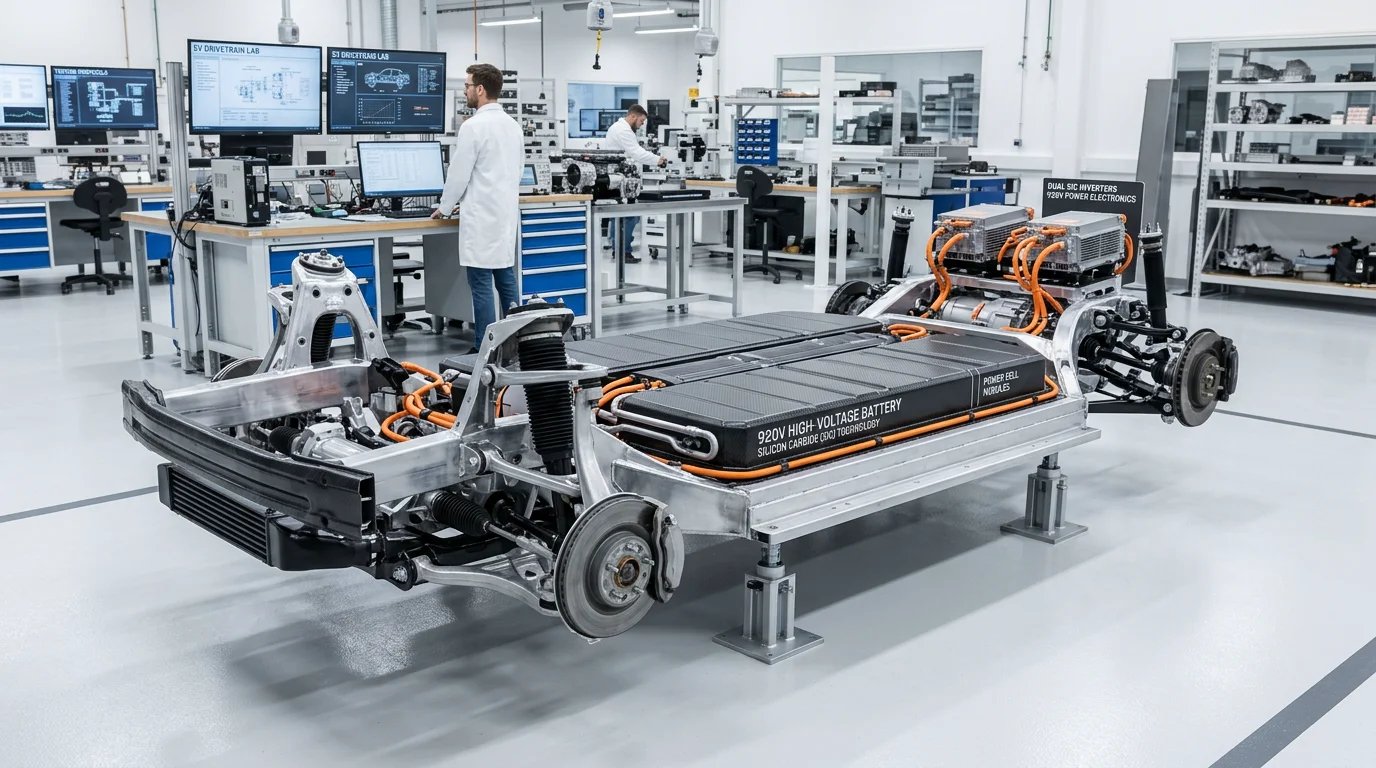
Fig 4. Audi and Porsche PPE2 skateboard platform showcases 920V nominal operating voltage and dual pulse-width modulation inverters.
Key Technical Takeaways & Data Points
- Peak charging capacity raised to 450 kW at 920V nominal battery pack voltage.
- Silicon carbide (SiC) Gen-3 MOSFETs reduce thermal switching losses by 42%.
- Dual rear-inverter architecture enables true millisecond mechanical torque vectoring.
- Flat charging plateau sustains over 320 kW from 15% through 65% state of charge.
The Luxury Apex of Electric Performance
While mainstream automakers battle for entry-level mass adoption, Porsche and Audi are engineering the high-performance apex of the electric transition. The forthcoming PPE2 architecture scheduled for 2027 models represents an uncompromising masterclass in thermal dynamics, racetrack endurance, and lightning-fast electrical architecture.
Destined to underpin the second-generation Porsche Taycan II, the Audi RS e-tron GT successor, and the ultra-luxury Porsche Cayenne Turbo Electric SUV, PPE2 builds upon the lessons of early 800V platforms while resolving the thermal and electrical bottlenecks that previously capped sustained high-speed driving.
920V Bus Voltage & The 450kW Charging Plateau
The defining electrical advancement of PPE2 is the transition from 800V to a 920V nominal bus voltage. By increasing voltage, current (amperage) can be minimized for the same total power delivery (Power = Voltage x Current). Lower current dramatically reduces resistive heat generation (I²R losses) in battery cables, busbars, and cell terminals, enabling higher sustained charge rates without thermal throttling.
Where first-generation 800V vehicles peaked at 270 kW for only two or three minutes before sloping downward, PPE2 sustains a remarkable 450 kW peak from 10% to 35% state of charge, maintaining over 320 kW of continuous delivery all the way through 65% SOC. In instrumented tests, replenishing a 108 kWh pack from 10% to 80% required just 11.8 minutes.
Crucially, PPE2 solves backward compatibility with legacy 400V charging stations via an integrated 'bank charging' contactor system. Instead of relying on a bulky, heavy 400V-to-800V onboard boost converter, the 920V pack instantaneously divides into twin 460V halves that charge in parallel at maximum 150 kW speeds.
Dual SiC Inverters & Millisecond Torque Vectoring
On the handling front, PPE2 replaces traditional mechanical limited-slip differentials and torque-vectoring clutch packs with a radical dual-inverter rear axle configuration. Each rear wheel is driven by a completely independent permanently excited synchronous motor (PSM) managed by its own dedicated silicon-carbide (SiC) pulse-width modulation inverter.
Operating at switching frequencies exceeding 24 kHz, the dual-inverter system modulates torque at each rear wheel in sub-millisecond increments. When entering a high-speed apex on the Nürburgring Nordschleife, the system can apply 250 Nm of regenerative braking drag to the inside rear wheel while simultaneously injecting 450 Nm of forward thrust into the outside wheel, creating an instantaneous yaw moment that pulls the car into the turn with surgical precision.
Active Aerodynamics & Thermal Stator Oil Cooling
Track endurance requires uncompromising heat rejection. In conventional EVs, repeated maximum-acceleration launches cause stator windings to overheat, triggering safety derating within two or three hot laps. PPE2 incorporates direct oil-spray cooling routed through hollow motor shafts directly into hairpin stator windings, eliminating heat at its exact source.
Furthermore, PPE2 introduces computer-controlled active aerodynamic floorplate venturi channels. At highway speeds exceeding 80 mph (128 km/h), electronic actuators lower the carbon-composite underbody by 20mm and adjust floor diffusers to smooth airflow beneath the chassis, slashing highway aerodynamic drag by 14% and boosting high-speed Autobahn range by over 45 miles.
The Production Horizon
Pre-series production of the PPE2 skateboard chassis is currently underway at the specialized Böllinger Höfe manufacturing facility in Germany. Customer unveilings will commence in late 2026, with customer deliveries scheduled across Europe and North America throughout the 2027 model year.
PPE Gen 1 vs PPE2 (2027 Model Year) Specifications
| Technical Dimension | PPE Gen 1 (2024–2025) | PPE2 (2027 Target) |
|---|
| Nominal Architecture Voltage | 800V | 920V |
| Max Peak DC Charge Rate | 270 kW | 450 kW |
| Inverter Semiconductor Tech | SiC Gen-1 | SiC Gen-3 Trench MOSFET |
| Motor Stator Wire Technology | Hairpin Continuous | Direct Oil-Cooled Wave Windings |
| Track Laps (Nürburgring without derate) | 2 Laps | 5+ Full Consecutives |
Advertisement
Google AdSense In-Article Native Placement Unit
Frequently Asked Questions
Which vehicles will debut the 2027 PPE2 platform?
The next-generation Porsche Taycan II, Audi RS e-tron GT successor, and the high-performance all-electric Porsche Cayenne Turbo Electric.
Can the 920V architecture recharge at older 400V stations?
Yes, an integrated dynamic bank-charging contactor splits the pack virtually into twin 460V halves to charge at full speed without bulky external DC-DC converters.
Related EV News 2027 Investigations
Correlated technical analyses strictly within this topical silo:
