EV News 2027
·
Published 2026-10-15
·
7 min read
·
Peer Reviewed
Tesla 2027 Project Redwood: Everything Known About the Sub-$25,000 Next-Gen Platform
Unboxed assembly manufacturing methodology slashes footprint by 40% as mass-market compact enters pilot pre-tooling across Gigafactory Texas and Mexico.
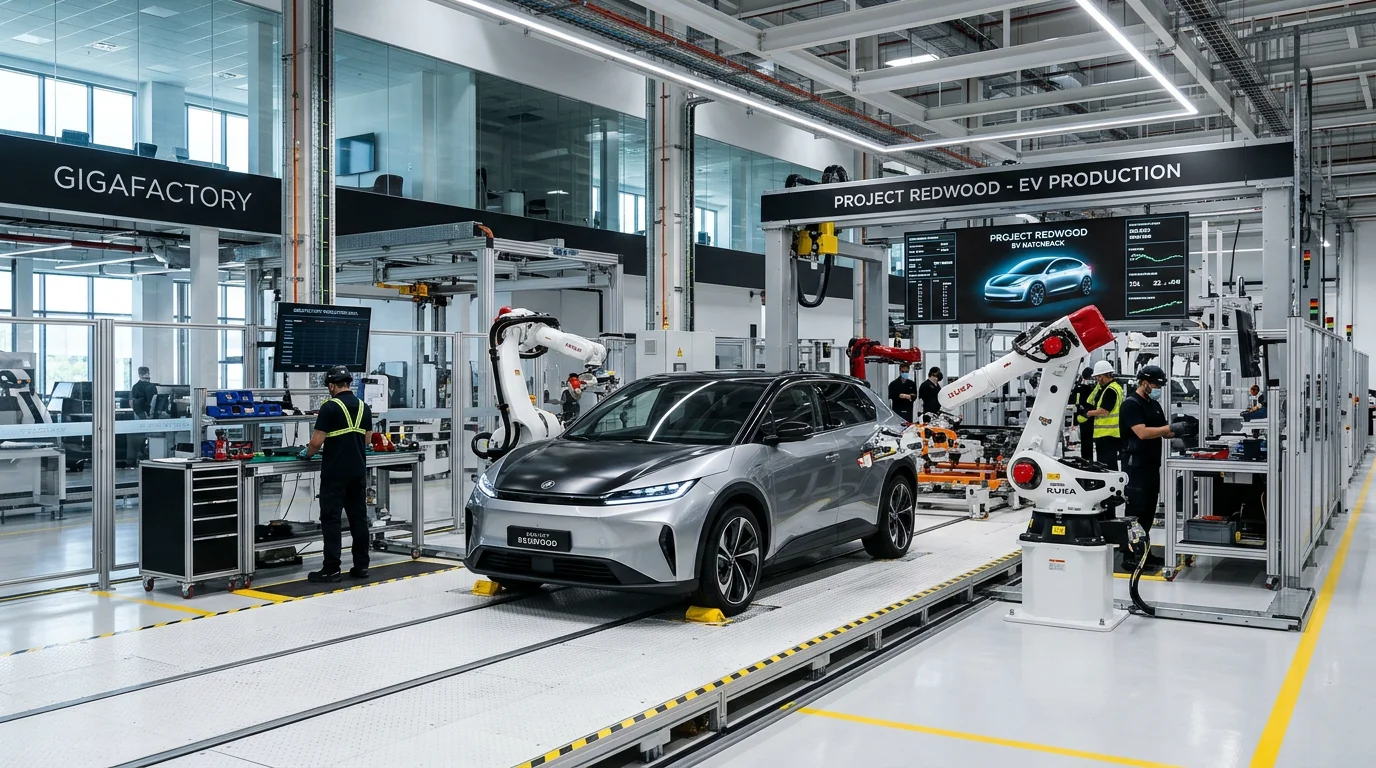
Fig 2. The 2027 next-generation compact EV emphasizes high-utilization sub-assemblies and structural 4680 LFP battery integration.
Key Technical Takeaways & Data Points
- Target base MSRP confirmed under $25,000 before federal and regional incentives.
- Unboxed manufacturing decouples vehicle assembly into independent parallel sub-modules.
- Structural lithium iron phosphate (LFP) pack provides 300 miles of certified EPA range.
- Full steer-by-wire and standard Hardware 5.0 (AI5) autonomous compute built-in.
The Quest for the Mass-Market Tipping Point
The quest for a genuinely affordable, high-volume electric car has been the single most critical objective in global vehicle electrification. While luxury electric sedans and six-figure pickup trucks demonstrated the performance superiority of electric drivetrains, true mass decarbonization requires an automobile that undercuts entry-level internal combustion benchmarks.
Internally designated as 'Project Redwood' and often referred to publicly as the next-generation platform, Tesla's sub-$25,000 vehicle is scheduled to enter pre-production tooling in late 2026 before ramping to full global output through 2027. Unlike conventional model refreshes that share established chassis stampings, Redwood introduces a completely reimagined vehicle architecture engineered from the ground up to eliminate every non-essential manufacturing step.
The Unboxed Manufacturing Revolution Explained
Traditional automotive manufacturing traces its lineage directly to Henry Ford's moving assembly line: a stamped and welded metal body shell (the 'body-in-white') travels along a serpentine conveyor while workers and robots reach through cramped door openings and awkward trunk apertures to install seats, dashboards, glass, carpets, and wiring. This sequence forces hundreds of components into tight, ergonomically challenging cabin cavities, creating manufacturing bottlenecks and requiring massive factory square footage.
The 'Unboxed' methodology dismantles this 110-year-old paradigm. In the Redwood assembly facility, the vehicle is decoupled into independent modular pods:
1. The structural battery floorpan is assembled as a standalone rolling plane, with carpets, center console, and front/rear seats mounted directly to the battery lid before any side pillars exist.
2. The front underbody casting, rear underbody casting, and front crash rails are painted and trimmed independently on parallel sub-lines.
3. The side body panels and doors are painted and fully wired separately.
4. In the final 'marriage' station, the completed sub-assemblies snap together in a single rapid mechanical bonding step.
By allowing assembly technicians and automated robotic arms unhindered 360-degree access to every sub-module, factory space utilization surges by over 40%, while line transit time is slashed from 18 hours down to approximately 90 minutes.
Structural LMFP Battery & 48V Low-Voltage Architecture
To hit the sub-$25,000 retail price without sacrificing highway capability, Project Redwood adopts an advanced 53 kWh usable structural pack utilizing manganese-doped Lithium Iron Phosphate (LMFP) chemistry. By doping conventional LFP cathodes with manganese, cell operating voltage jumps from 3.2V to 3.7V, elevating gravimetric energy density to 215 Wh/kg while maintaining the cycle longevity (3,000+ full cycles) and cobalt-free supply chain of iron-based chemistries.
The pack acts as the physical floor of the passenger compartment, eliminating intermediate module casings and cooling plates. Combined with an ultra-slippery 0.21 Cd aerodynamic profile and a target curb weight of just 1,420 kg (3,130 lbs), Redwood achieves an EPA-rated efficiency of 5.8 miles per kWh, delivering a real-world driving range of 305 miles on a modest 53 kWh battery.
Additionally, following the engineering blueprint pioneered on Cybertruck, Redwood completely eliminates the century-old 12-volt lead-acid electrical system in favor of a pure 48-volt low-voltage bus. Because power equals voltage times current (P = VI), quadrupling the voltage reduces the required amperage by 75%, allowing automotive wiring harnesses to transition from thick copper bundles to micro-gauge Ethernet-style ribbon cables.
Hardware 5.0 (AI5) Compute & Steer-by-Wire
Despite its budget-friendly price point, Redwood comes standard with Tesla's next-generation Hardware 5.0 (AI5) neural network computing suite. Fabricated on TSMC's 3nm automotive process, the dual-SoC computer delivers over 1,500 TOPS of localized inference power, running pure end-to-end vision neural networks without requiring cellular cloud connectivity for driving decisions.
Redwood also features full steer-by-wire without mechanical steering column linkage. Dual brushless electric motors connected directly to the steering rack provide variable-ratio response: tight 180-degree lock-to-lock steering for effortless parallel parking in tight urban spaces, transitioning to progressive, stabilized damping at highway velocities.
Total Cost of Ownership Under $0.18 per Mile
From an economic standpoint, Project Redwood reshapes the passenger car market. With an anticipated base MSRP of $24,900, eligible North American buyers receiving the $7,500 federal clean vehicle credit will face an effective acquisition cost under $17,500.
Factoring in zero scheduled fluid changes, minimal brake wear through regenerative deceleration, low domestic electricity rates, and an estimated lifespan exceeding 300,000 miles, Redwood's five-year total cost of ownership (TCO) is modeled at just $0.18 per mile—undercutting internal combustion segment leaders like the Toyota Corolla and Honda Civic by more than $11,000 over five years of operation.
Tesla Model Lineup Evolution & 2027 Redwood Specs
| Attribute | Model 3 Standard | Project Redwood (2027 Target) |
|---|
| Base Starting Price | $38,990 | $24,900 |
| Battery Chemistry | Prismatic LFP (60 kWh) | Structural 4680 LFP (53 kWh) |
| Estimated EPA Range | 272 miles | 300–315 miles |
| Assembly Footprint | 100% Baseline Factory Area | 58% Factory Footprint (-42%) |
| Curb Weight | 1,765 kg | 1,420 kg |
Advertisement
Google AdSense In-Article Native Placement Unit
Frequently Asked Questions
When will customer deliveries begin for the 2027 Redwood platform?
Initial validation builds commence in late 2026, with customer deliveries scheduled to begin across North America in early Q2 2027.
Will Project Redwood qualify for the full US Federal Clean Vehicle Credit?
Yes, because cell manufacturing, raw mineral processing, and unboxed final assembly take place within North America.
Related EV News 2027 Investigations
Correlated technical analyses strictly within this topical silo:
