
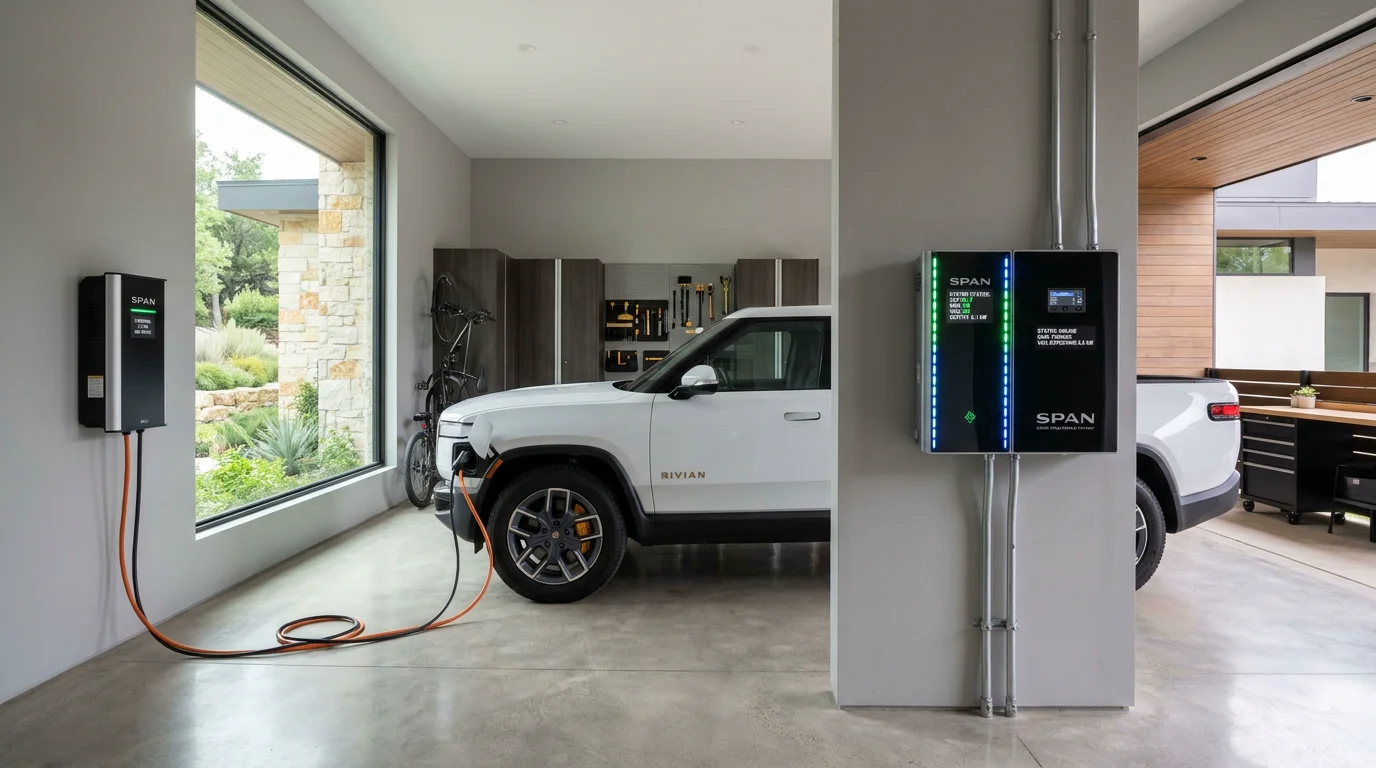
For decades, residential emergency power backup required either noisy, polluting fossil-fuel generators or expensive stationary lithium wall batteries costing $12,000 to $16,000 for a modest 13.5 kWh capacity. Meanwhile, parked directly inside millions of residential garages sits an electric car with a battery pack holding between 65 kWh and 130 kWh—enough clean electricity to sustain an average American household for three to seven days during a severe grid outage.
How Vehicle-to-Home (V2H) Bidirectional Power Works
Standard electric car charging is unidirectional: alternating current (AC) flows from your home electrical panel into the vehicle's onboard charger, which converts it to direct current (DC) to store in the battery pack. In a bidirectional Vehicle-to-Home (V2H) system, that flow is reversed: stored DC battery energy flows back through the charging cable, converts to 120V/240V split-phase AC power, and energizes your home's breaker panel.
There are two primary bidirectional topologies: - DC-Coupled Architecture (ISO 15118-20): Raw high-voltage DC flows directly from the vehicle battery to a high-capacity stationary wall inverter (such as the Ford Charge Station Pro or Tesla Powershare Gateway). This allows continuous outputs up to 11.5 kW (48 amps), capable of starting central air conditioning compressors, electric ovens, and well pumps simultaneously. - AC-Coupled Architecture: The vehicle's onboard inverter converts DC to AC internally, outputting standard 120V/240V AC through specialized bidirectional EVSE. While hardware costs are lower, maximum continuous output is typically limited to 4.8 kW to 7.2 kW.
Microgrid Islanding & Automatic Transfer Switches
When the municipal electrical grid collapses during an ice storm or hurricane, safety protocols require your home to instantaneously disconnect from the main utility feeder lines—a process known as 'islanding'. Without automated islanding, your car could back-feed high voltage into neighborhood power lines, posing a fatal electrocution hazard to utility lineworkers repairing damaged transformers.
Modern V2H home energy gateways feature automatic motorized transfer switches that detect grid voltage collapse and isolate your residential circuits in less than 16 milliseconds. Transition is so instantaneous that home computers, Wi-Fi routers, and clocks do not reset.
Battery Longevity and Warranty Implications
A common concern among EV owners is whether using their car as a home emergency battery will degrade the battery prematurely. In reality, residential backup is remarkably gentle on automotive cells: - Running an entire home draws between 1.5 kW and 4.0 kW of power, representing a tiny 0.04C discharge rate for an 80 kWh pack (compared to 150 kW+ during highway acceleration). - Over a multi-day emergency blackout, a home might cycle through 40% to 60% of pack capacity just once or twice per year. - Major automakers supporting V2H (including Ford, GM, Tesla, and Hyundai) explicitly cover bidirectional home backup within their standard 8-year / 100,000-mile factory battery warranties, provided certified bidirectional hardware is installed.
Hardware Costs, ROI, and Federal 30% Tax Credits
Installing a complete V2H ecosystem typically involves: 1. Bidirectional wall connector & high-power inverter: $3,500 – $4,500 2. Microgrid automated transfer gateway & smart subpanel: $1,800 – $2,500 3. Professional electrical permit and installation labor: $2,000 – $3,500 Total installed cost averages between $7,500 and $10,500. Under Section 25C and 30C of the federal clean energy statutes, homeowners can claim a 30% federal tax credit on the hardware and installation, lowering net out-of-pocket costs to approximately $5,200—less than half the price of a single standalone wall battery with a fraction of the storage capacity.