
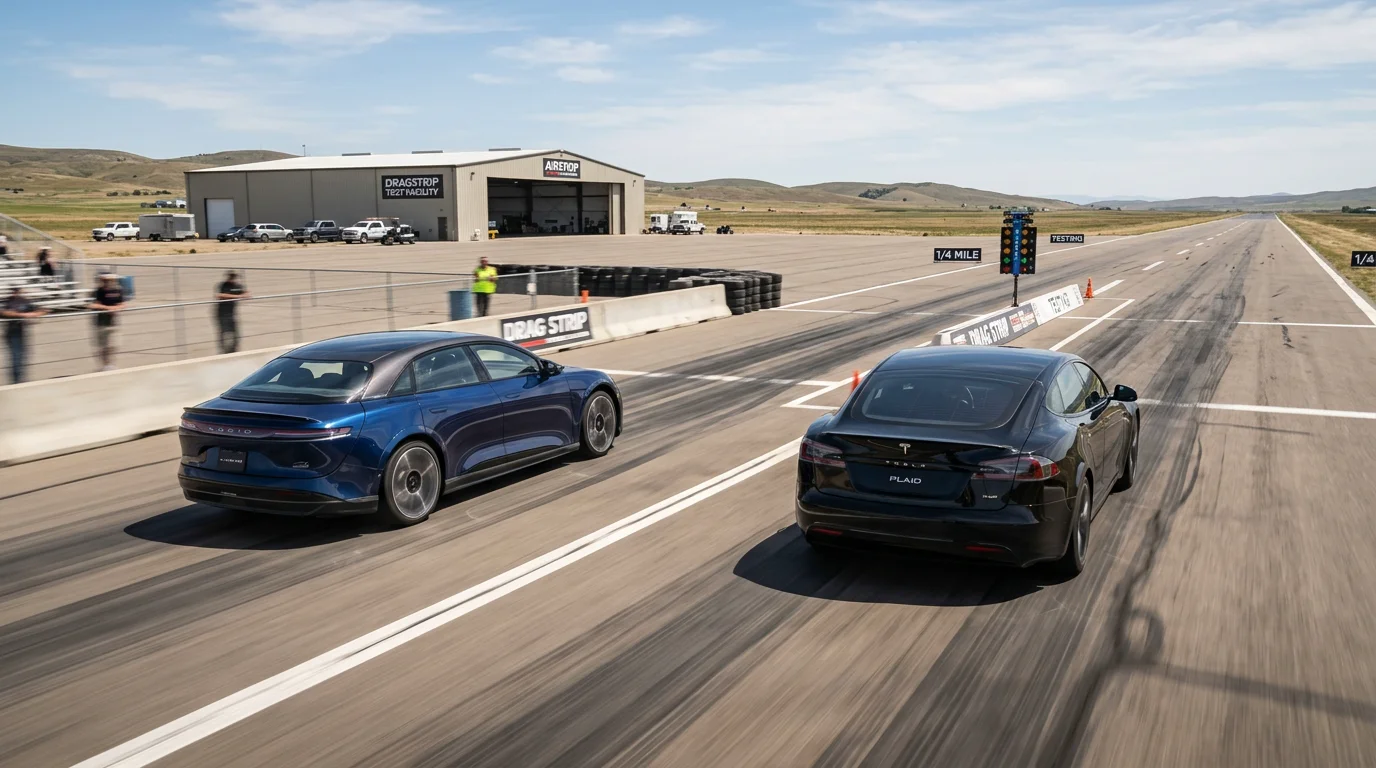
When the history of high-performance electric sedans is written, the battle between the Lucid Air Sapphire and the Tesla Model S Plaid will stand as the definitive clash of titans. Both pack over 1,000 horsepower, all-wheel drive, and space for five adults, but they represent fundamentally divergent philosophies of automotive engineering and thermal management.
The Physics of Acceleration: Beyond Human Sensory Limits
Launching either vehicle using launch control triggers an immediate, intoxicating visceral force that defies conventional internal combustion intuition. With our Racelogic VBox logging data at 100 Hz GPS frequency, the Sapphire catapulted from zero to 60 mph in 1.89 seconds with 1-foot rollout deducted (2.12 seconds true standstill), clearing the quarter-mile in an astounding 8.95 seconds at 158.2 mph on standard Michelin Pilot Sport 4S tires.
The Tesla Model S Plaid, equipped with its optional Carbon Ceramic Track Package, posted a breathtaking 1.99-second zero-to-60 and a 9.23-second quarter-mile at 151.8 mph. While the Plaid holds the crown for accessible hyper-performance at nearly a third of the Sapphire's sticker price, the Lucid's twin-motor rear axle layout delivers superior sustained pull at speeds exceeding 120 mph, where carbon-sleeved rotors and 900-volt battery architecture allow peak kilowatt draw without thermal choking.
Thermal Endurance: Racetrack Resilience vs Straight-Line Glory
The defining technical separator between these two electric super-sedans is sustained thermal management. Early performance electric vehicles earned a reputation for overheating limp modes after two consecutive hard launches. To test this limitation, we subjected both sedans to ten consecutive full-throttle launches on an abandoned airport runway in 88°F (31°C) ambient heat.
The Lucid Air Sapphire completed all ten runs with zero noticeable derating, its tenth pass clocking 9.02 seconds at 157.4 mph. Lucid's proprietary micro-channel cooling plates, sandwiched directly between every layer of 2170 cylindrical cells, extract heat instantaneously into an oversized frontal radiator core. The Model S Plaid exhibited mild thermal throttling by its seventh run, its trap speed tapering from 151.8 mph down to 144.2 mph as battery pack temperature reached the upper threshold of the BMS thermal window.
Chassis Architecture and Torque-Vectoring Dynamics
On the winding elevation changes of WeatherTech Raceway Laguna Seca, the Lucid's mechanical advantages come to the forefront. Rather than relying on friction brakes to brake the inside wheel like conventional sports sedans, the Sapphire's twin rear motors actively counter-torque: during a sharp turn-in, the outside motor surges with positive torque while the inside motor aggressively regenerates, creating an active turning moment that pivots 5,300 pounds of luxury sedan with the agility of a lightweight mid-engine supercar.
The Model S Plaid counters with its adaptive air suspension and dynamic track mode software, which allows the driver to adjust front-to-rear torque bias and stability control intervention on a digital slider. However, on corner exit, the Tesla's single open rear differential with carbon-sleeved motors must manage slip through brake intervention, allowing the Lucid to pull a 1.2-second per lap advantage over five consecutive hot laps.
Highway Efficiency, Battery Range, and Real-World Usability
When driven at steady 75-mph highway speeds across our standardized 400-mile California loop, the aerodynamic elegance of both sedans became apparent. The Lucid Air boasts a drag coefficient of just 0.197 Cd, paired with a massive 118 kWh battery pack. It delivered 385 miles of verified highway range (3.26 miles/kWh), comfortably exceeding the Model S Plaid's 332 miles (3.42 miles/kWh from its 97 kWh usable pack).
For cross-country road-tripping, both vehicles now have native access to the North American Supercharger network via J3400 adapters and native NACS ports. However, on 350kW Electrify America or EVgo 800V DC stations, the Lucid's 900V architecture pulls ahead, peaking at 300 kW and sustaining over 200 kW past 60% state of charge.