
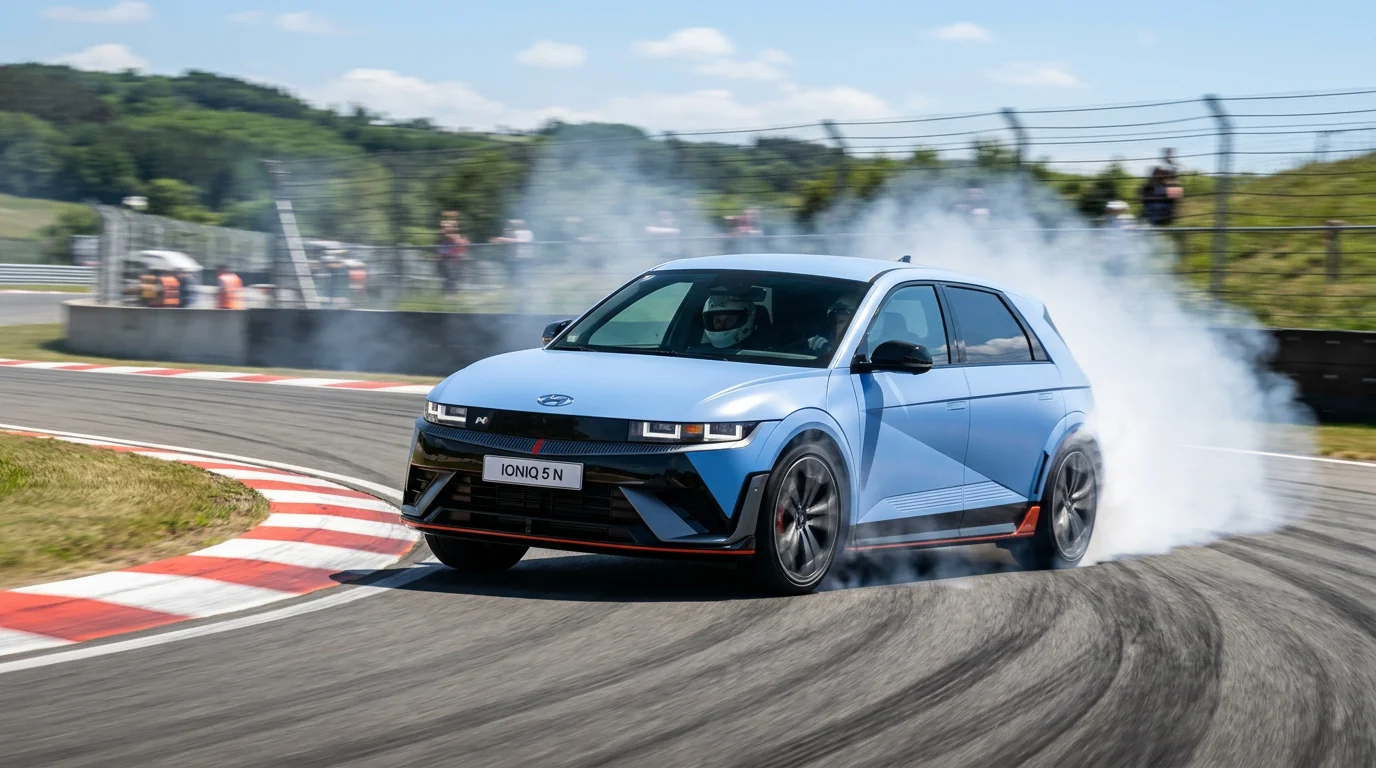
For enthusiasts who grew up on mechanical limited-slip differentials, manual gearboxes, and communicative combustion notes, the first generation of electric performance cars felt clinical. Rapid, undeniably, but emotionally sterile—a flat wave of torque that delivered speed without engagement. The engineers at Hyundai's high-performance N division set out to shatter that paradigm with the 641-horsepower Ioniq 5 N.
N e-Shift: Engineering Artificial Imperfection
The philosophical breakthrough of the Ioniq 5 N is 'N e-Shift'. Traditional EV engineering aims for seamless continuous acceleration. Hyundai's engineers did the exact opposite: they programmed the front and rear permanent magnet motors to simulate the physical torque interruption of an 8-speed wet dual-clutch transmission.
When you pull the right steering-wheel paddle at 7,800 simulated RPM, the motor controllers momentarily cut power for 80 milliseconds, creating a physical jolt through the chassis before surging forward in the next virtual gear ratio. If you forget to upshift, the vehicle bounces off a digital rev-limiter, holding RPM and refusing to accelerate until you click the paddle. In blind track testing, seasoned racing drivers reported that the auditory and physical cadence made it drastically easier to judge braking points and corner entry speeds without glancing down at the digital speedometer.
N Active Sound+: Psychoacoustic Realism
Paired with simulated shifting is 'N Active Sound+', which utilizes eight interior speakers and two external acoustic transducers. Unlike cheesy synthesized humming tones found in other electric cars, Hyundai sampled the authentic intake whoosh, exhaust pops, and overrun crackles of the championship-winning Elantra N TCR racecar.
When downshifting under heavy braking into a hairpin turn, the system emits realistic pops and bangs that resonate through the vehicle floor. For drivers who prefer silence, the sound system can be muted instantly with a single button on the steering wheel.
Thermal Battery Preconditioning: Sprint vs Endurance Modes
Where most high-performance EVs overheat their battery packs after three or four laps of hard track driving, the Ioniq 5 N features an advanced dual-radiator cooling loop and specialized motor oil coolers. Before entering the pit lane, drivers can choose between two dedicated track preconditioning profiles: - Sprint Mode: Cools the 84 kWh battery to 86°F (30°C) to maximize peak power delivery for single-lap qualifying heroics. - Endurance Mode: Pre-cools the pack to 68°F (20°C) and limits peak torque spikes to 580 hp, allowing 20+ consecutive hot laps on a 2.5-mile road course without triggering thermal power reductions.
Braking Dynamics: 0.6G Regenerative Deceleration
Track driving demands immense braking endurance. The Ioniq 5 N features massive 400mm front steel rotors clamped by 4-piston monoblock calipers. However, up to 0.60G of initial braking force is delivered entirely by regenerative electric motor braking—twice the regen capacity of standard passenger EVs.
By relying heavily on motors to scrub off high-speed velocity, mechanical brake pad temperatures remain over 200°C cooler than traditional gasoline sports cars, virtually eliminating brake fade over a full 30-minute track session.