
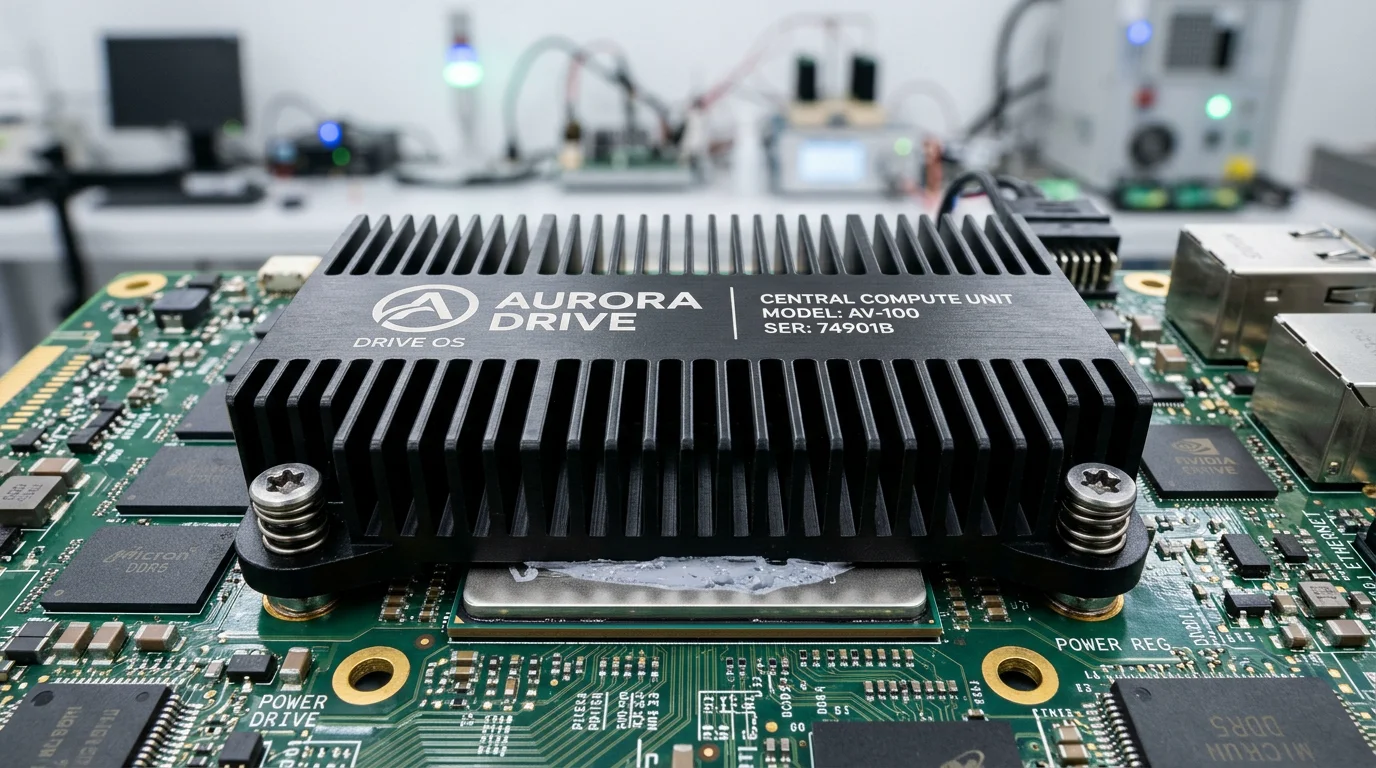
The automotive industry is undergoing the greatest architectural consolidation in its history. Vehicles are no longer mechanical machines with auxiliary electronic microcontrollers; they are rolling, software-defined data centers on wheels. At the center of this revolution is the fierce semiconductor duel between NVIDIA's Drive Thor and Qualcomm's Snapdragon Ride Flex.
Consolidating Distributed Electronic Control Units (ECUs)
Historically, a modern luxury passenger vehicle harbored between 80 and 130 discrete microcontrollers scattered across the chassis: one for electric windows, another for heated seats, another for blind-spot radar, and separate boxes for navigation and anti-lock brakes. This distributed topology required miles of point-to-point copper wiring harnesses weighing upwards of 65 kg (143 lbs), making manufacturing cumbersome and preventing over-the-air (OTA) updates to critical powertrain systems.
Centralized domain controllers replace this distributed spaghetti with a single monolithic System-on-Chip (SoC). A single liquid-cooled centralized compute box running real-time hypervisors simultaneously manages digital instrument clusters, multi-screen infotainment, Level 2+/Level 3 autonomous driving models, and body gateway routing.
NVIDIA Drive Thor: The 2,000 TOPS Transformer Powerhouse
Engineered on TSMC's customized 4NP process node, NVIDIA Drive Thor integrates next-generation Blackwell GPU architecture alongside Grace CPU cores. Delivering up to 2,000 TOPS (Tera Operations Per Second) of FP8/FP4 tensor compute, Thor is specifically architected to execute large multi-modal generative vision models in real time.
With unified LPDDR5X memory bandwidth exceeding 1.2 Terabytes per second, Thor eliminates the memory latency bottlenecks that previously capped end-to-end autonomous vision models. Automotive manufacturers can partition Thor's silicon via hardware-isolated ASIL-D safety islands, ensuring that even if an infotainment streaming application freezes, steering and emergency collision avoidance algorithms continue executing with zero latency.
Qualcomm Snapdragon Ride Flex: Low-Power Multi-Domain Mastery
Qualcomm's response is the Snapdragon Ride Flex family, manufactured on an advanced 3nm FinFET process. Where NVIDIA emphasizes raw tensor compute for Level 3/4 autonomy, Qualcomm leverages its decades of mobile low-power leadership to deliver an exceptionally efficient 1,400 TOPS platform operating within a thermal design envelope (TDP) under 110 watts.
Snapdragon Ride Flex excels in mixed-criticality execution: running safety-critical QNX real-time operating systems for vehicle dynamics alongside Android Automotive OS for multimedia within a single chip. Its integrated cellular 5G and C-V2X (Cellular Vehicle-to-Everything) transceivers provide native gigabit cloud telemetry and vehicle-to-infrastructure handshaking.
Thermal Engineering & In-Vehicle Liquid Cooling
Dissipating 150 to 220 watts of continuous electrical heat inside a sealed automotive dashboard is an extreme engineering challenge. Modern domain computers utilize closed-loop dielectric liquid cooling plates tied into the vehicle's primary heat pump thermal loop. During extreme cabin temperatures ranging from -40°C in winter testing to 85°C parked under direct Arizona desert sunlight, automotive silicon maintains full clock frequencies without thermal throttling.