
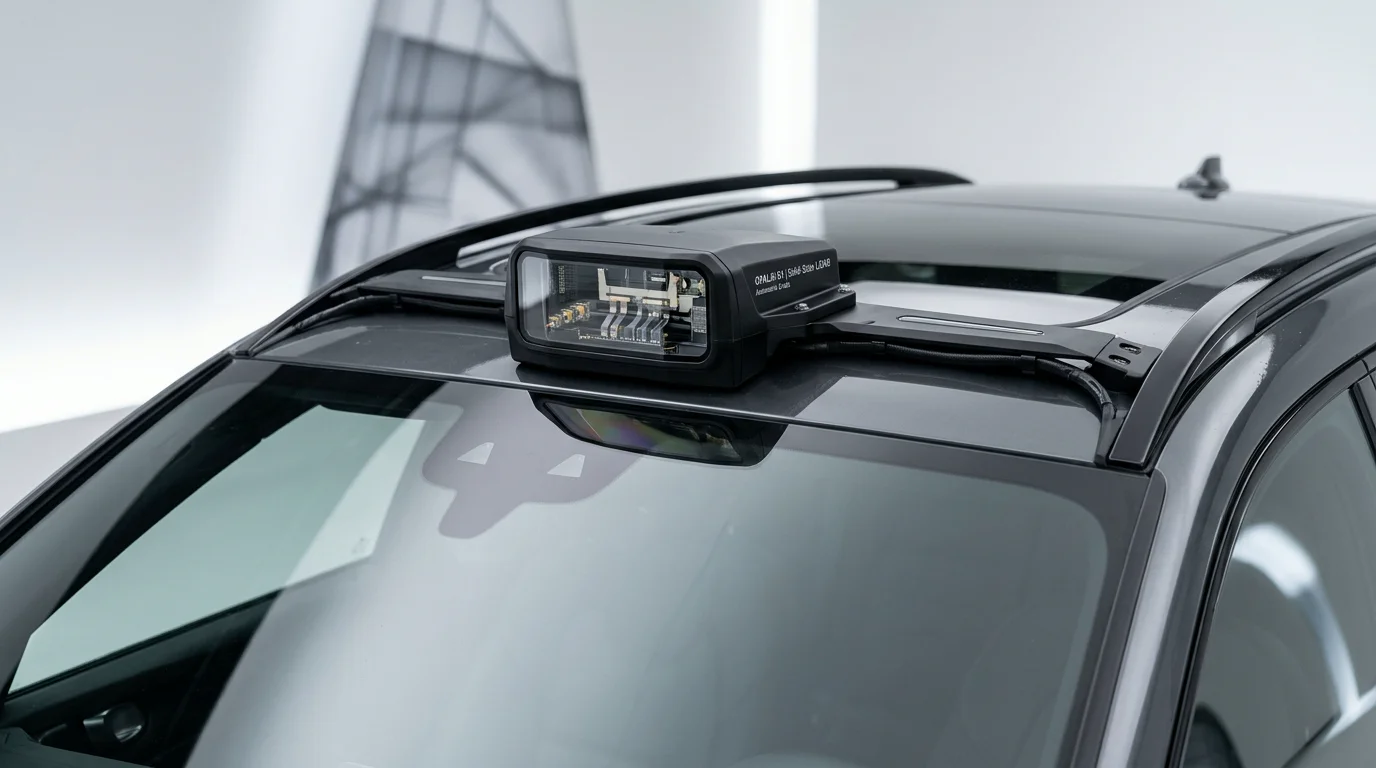
For half a decade, Silicon Valley autonomous software developers and legacy global automakers were locked in an ideological war. One camp argued that because human beings navigate roads using biological vision alone, artificial neural networks need nothing more than cameras. The opposing camp maintained that safety-critical autonomy requires the deterministic photon time-of-flight measurements of active laser radar (LiDAR).
The Collapse of the LiDAR Cost Curve
The turning point that settled this debate into an engineering consensus was semiconductor foundries successfully etching Optical Phased Arrays (OPA) and micro-electro-mechanical systems (MEMS) directly onto silicon wafers. By eliminating bulky spinning electric motors, rotating mirrors, and manual laser diode alignments, manufacturing yields surged, causing unit costs to collapse from over $10,000 in 2019 to under $280 per automotive-grade solid-state unit today.
FMCW LiDAR: Doppler Velocity at the Speed of Light
Modern solid-state sensors operate on Frequency Modulated Continuous Wave (FMCW) photonics using 1550nm eye-safe infrared lasers. Unlike legacy pulsed time-of-flight sensors that measure distance by timing individual light bursts, FMCW emits a continuous chirped laser beam. By measuring the frequency phase shift of returning photons, the sensor instantaneously calculates not only distance, but the precise radial Doppler velocity of every point in the cloud within a single frame.
This allows an autonomous vehicle traveling at 75 mph in heavy fog to instantly differentiate between a stationary stalled semi-truck and a moving vehicle at 350 meters distance, eliminating false-positive braking events.
Sensor Fusion: The Redundancy Imperative for Level 3 Autonomy
While pure vision neural networks have advanced exponentially with HDR automotive sensors and generative world models, passive cameras remain inherently vulnerable to environmental edge cases: blinding sun glare reflecting off wet asphalt, heavy blizzards, dense sea fog, and mud splattered on camera lenses. Combining solid-state FMCW LiDAR with high-resolution HDR cameras and 4D imaging radar provides true sensor diversity, allowing commercial automakers to accept legal liability for hands-free Level 3 highway driving.