
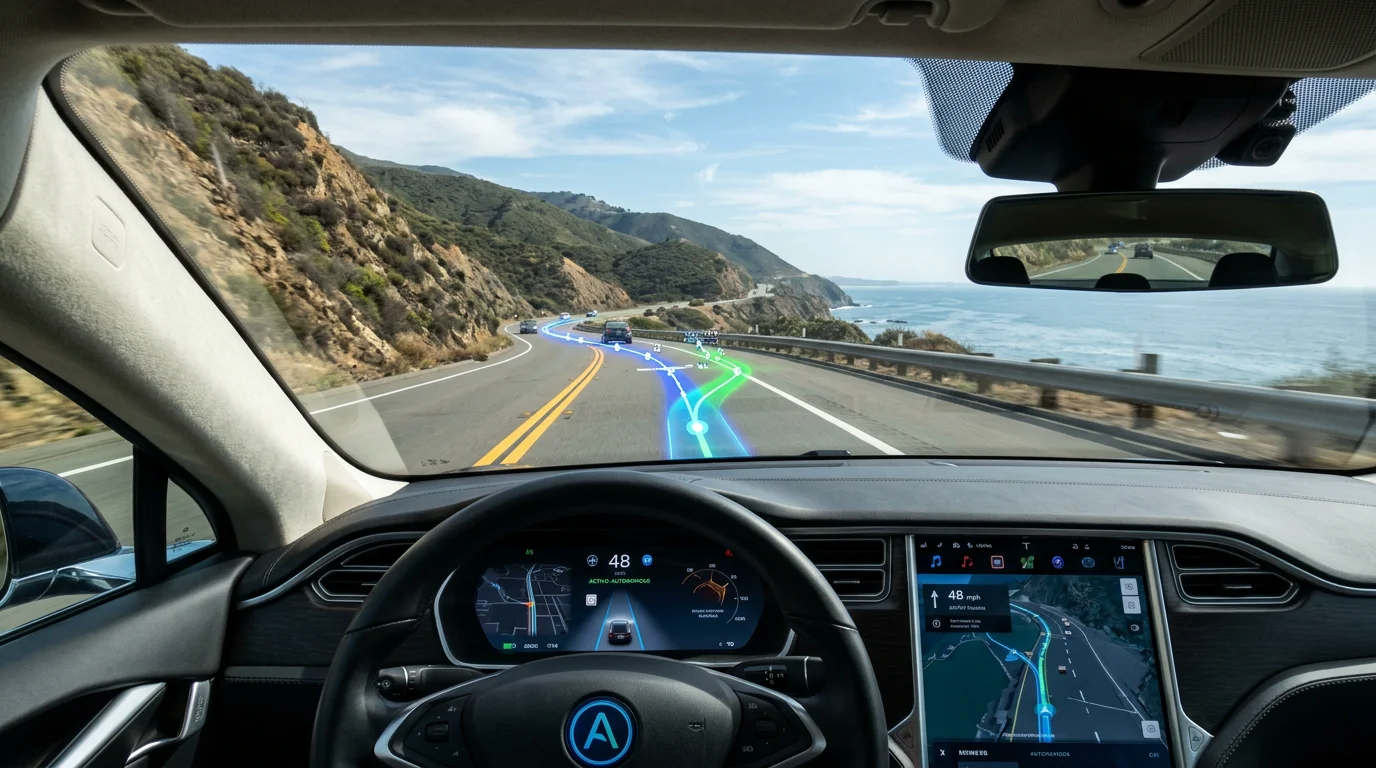
For over a decade, autonomous driving engineering was anchored to a modular, pipelined architecture: one neural network detected pedestrians, a second classified lane markings, a third fused radar and LiDAR points against pre-mapped 3D centimeter-accurate HD maps, and a deterministic planner written in hundreds of thousands of lines of explicit C++ code made driving decisions using hand-coded if/else rules. That classical robotics paradigm has now been completely dismantled.
The Structural Failure of Hand-Coded Heuristic Stacks
Human driving is inherently social, ambiguous, and continuous. Consider navigating a crowded intersection with a traffic cop waving hand signals, negotiating right-of-way with an aggressive delivery van double-parked on a narrow residential street, or creeping past a construction crew pointing flashlights around orange cones. Programmers could write code for twenty years and still never anticipate every real-world edge case.
In traditional heuristic systems, solving one edge case frequently broke another. Adding code to make the car pass stopped vehicles caused phantom braking when the car mistook a garbage truck for an obstruction. The resulting software stack grew to over 500,000 lines of fragile C++ heuristics that required constant manual patches and produced rigid, robotic hesitation.
Photons In, Controls Out: How End-to-End Vision Transformers Work
The breakthrough that redefined modern autonomous driving is the end-to-end (E2E) neural network architecture. In this paradigm, raw photons captured by eight or ten surround cameras feed directly into a temporal multi-modal vision transformer. The neural network's weights directly output vehicle actuation commands: steering angle, accelerator percentage, and brake pressure—at 36 frames per second.
Rather than converting the world into synthetic bounding boxes and digital vector lines, the neural network learns latent representations of 3D physical space, kinematics, and human behavioral intent. If an obstacle is partially occluded by steam from a manhole or heavy rain, the network does not discard the detection; its probability distribution smoothly navigates around the hazard with the fluid confidence of an experienced human driver.
Training Scale: 20 Billion Video Tokens on 50,000 GPUs
Building an end-to-end driving model is impossible without massive data compute. Leading autonomous programs train foundation models on vast GPU supercomputing clusters consuming billions of real-world driving video clips. Training data is curated using automated AI auto-labelers that identify and upweight rare driving events: wrong-way drivers, fallen tree branches, wild animals crossing country roads, and complex multi-lane roundabout merges.
By learning from tens of thousands of years of cumulative human driving experience, the model exhibits emergent behaviors: smoothly hugging the outside line on a blind curve to give room to oncoming trucks, gently easing onto lane shoulders to let emergency ambulances pass, and making decisive unprotected left turns across multi-lane boulevards.
Interpretability & Safety Verification: The Attention Heatmap Solution
Early regulatory critics expressed skepticism regarding end-to-end models, labeling them impenetrable 'black boxes'. To address this, modern autonomous runtimes generate real-time visual attention heatmaps and prediction tokens alongside actuation commands. Safety monitors can see exactly which pixels and objects the neural network attended to before initiating steering or braking maneuvers, satisfying ISO 26262 ASIL-D functional safety validation criteria.