
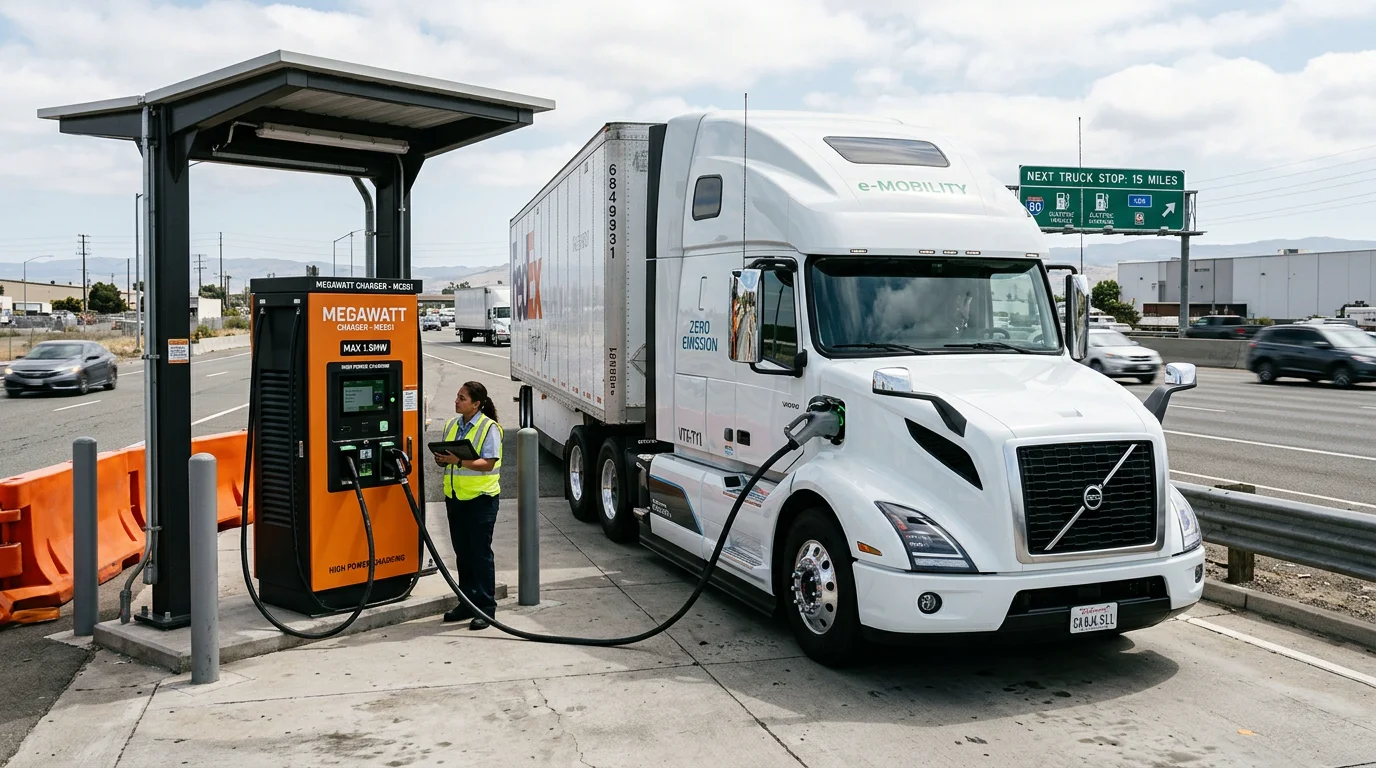
While consumer passenger cars account for personal transportation emissions, commercial Class 8 long-haul semi-trucks contribute an alarming 28% of all on-road transportation greenhouse gases. Decarbonizing an 80,000-pound combination tractor-trailer requires massive battery packs exceeding 800 kilowatt-hours (kWh). Recharging an 800 kWh pack on a passenger car fast charger would take hours—a delay that breaks commercial freight economics. The international Megawatt Charging System (MCS) standard solves this equation.
Solving the 30-Minute Federal Rest Break Equation
Federal Hours of Service regulations mandate that commercial long-haul truck drivers take a 30-minute rest break after eight hours of driving. With a standard 350kW passenger EV charger, replenishing an 800 kWh commercial pack would take two and a half hours. By delivering up to 3.75 megawatts of continuous direct current (up to 3,000 amps at 1,250 volts), an MCS dispenser replenishes 10% to 80% state-of-charge in just 28 minutes, adding 400 miles of highway range during the driver's required rest break.
Liquid Glycol Conductor Cooling & Ergonomic Design
Transmitting 3,000 amperes of electrical current through a standard copper conductor would normally require a cable so thick and heavy that a human truck driver could not lift it. MCS engineers solved this by circulating high-velocity liquid glycol directly around the terminal pins inside the plug handle. This active heat extraction keeps the connector lightweight, flexible, and easily manageable with one hand.
Stationary Battery Buffers: Preventing Substation Grid Strain
A ten-stall megawatt truck stop pulling full peak power could demand 30 megawatts of instantaneous load—equivalent to a small municipal city. To prevent overloading regional electrical substations, commercial MCS charging plazas incorporate on-site containerized 10 MWh to 20 MWh stationary Battery Energy Storage Systems (BESS). These stationary batteries trickle-charge continuously from the grid, discharging in rapid megawatt bursts into trucks without causing grid spikes.