
In the high-stakes technological race to unlock 500-mile electric vehicle ranges, battery engineering has experienced a critical fork in the road: the clash between radical solid-state architectures and advanced silicon-dominant anode chemistry. While solid-state cells capture mainstream media headlines, advanced silicon anodes are quietly establishing commercial mass dominance in high-performance EVs right now.
The Theoretical Graphite Ceiling
For thirty years, commercial lithium-ion batteries have relied on synthetic graphite anodes. Graphite is stable, affordable, and chemically predictable, but it has reached its absolute theoretical limit: it requires six carbon atoms to intercalate a single lithium ion (LiC6), yielding a maximum theoretical capacity of 372 mAh/g.
Silicon, by contrast, can bond with over four lithium atoms per single silicon atom (forming Li15Si4 alloys). This delivers a theoretical capacity of 3,579 mAh/g—nearly ten times higher than synthetic graphite. Replacing graphite with pure silicon allows a 30% reduction in battery pack volume and a 20% increase in gravimetric energy density.
Solving the 300% Volumetric Swelling Challenge
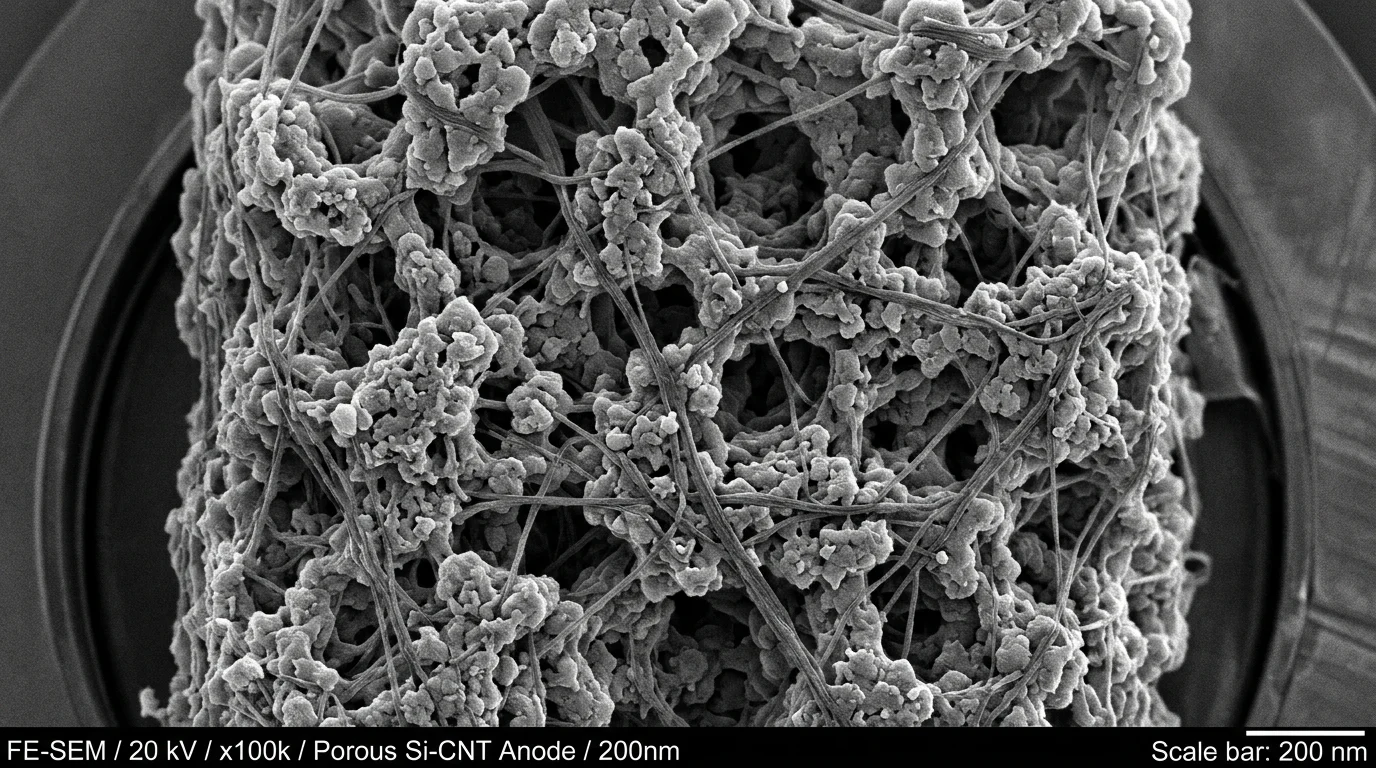
The historic challenge that prevented pure silicon anodes from reaching production was mechanical expansion. When silicon particles absorb lithium ions during charging, they swell by up to 300% in volume, pulverizing the particle structure and cracking the solid electrolyte interphase (SEI) layer during discharge cycles. Modern nanotechnology has resolved this through porous silicon nanowire scaffolding and carbon-nanotube elastic cages that accommodate internal expansion without outer mechanical stress.
Existing Gigafactory CapEx Drop-In Compatibility
The decisive economic advantage of silicon anodes over solid-state cells is capital expenditure. Producing solid-state batteries requires entirely new, specialized dry-room manufacturing facilities and isostatic high-pressure presses costing hundreds of millions of dollars. Nanostructured silicon anode slurries, however, are 100% drop-in compatible with existing roll-to-roll gigafactory coating equipment, giving silicon chemistry an immediate three-year commercial time-to-market advantage.